When you buy tires for your car, you might hear two main terms: passenger tire and performance tire. These words can seem confusing, but choosing the right one makes a big difference in your driving experience. The tires you pick affect your car’s safety, comfort, and even how much money you spend over time. If you have ever wondered which tire type is best for your needs, this guide will give you clear, practical answers.
Passenger tires and performance tires are not just about speed or looks. They have different features, materials, and designs made for specific purposes. Some people buy performance tires thinking they will always get better grip, but that’s not always true for everyday driving.
Others stick with passenger tires and miss out on the fun and control that performance tires can bring.
In this article, we will break down the key differences, benefits, and drawbacks of each type. We’ll also cover important things that many drivers overlook, like how tires affect fuel use, road noise, and even your car’s resale value. By the end, you’ll understand which tire is right for you—and you’ll avoid common mistakes that cost time and money.
What Are Passenger Tires?
Passenger tires are made for most cars, minivans, and small SUVs. These tires are designed for daily driving, not racing or high-speed cornering. If you drive your car mostly on highways, in the city, or just for family trips, you are probably using passenger tires.
Passenger tires focus on a soft, smooth ride. Their tread pattern and rubber compound are balanced for comfort, good wear life, and safety on wet and dry roads. They are not made for extreme handling, but for reliability and everyday use.
Many people choose passenger tires because they are affordable and last a long time.
Some features of passenger tires include:
- Tread patterns for good grip in rain and light snow
- Low rolling resistance for better fuel economy
- Softer sidewalls for a smoother ride
- Long tread life, often 60,000 miles or more
Passenger tires are labeled with the letter “P” (for Passenger) in front of the tire size, like P215/60R16. They are found on most cars you see on the road.
What Are Performance Tires?
Performance tires are built for speed, grip, and handling. They are used on sports cars and high-performance vehicles, but some drivers put them on regular cars for better control. If you like to drive fast, take sharp corners, or want a “sporty” feel, you might consider performance tires.
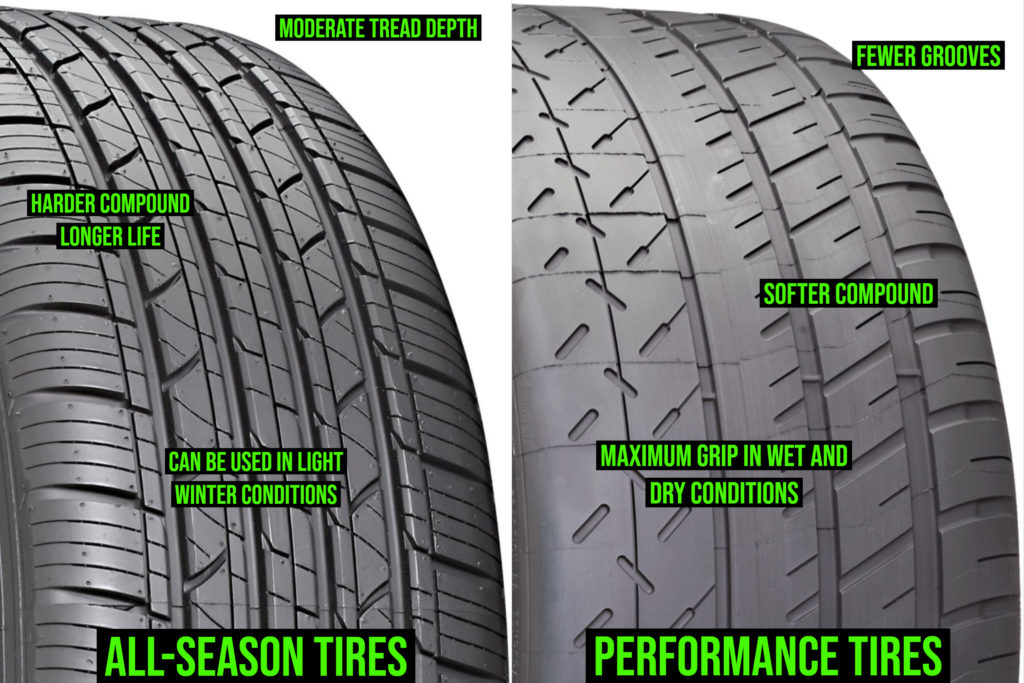
Performance tires use a special rubber compound that’s stickier than regular tires. Their tread pattern is made to push water away quickly and give more contact with the road. The sidewalls are stiffer, so the car feels more connected to the pavement.
Performance tires often come with a speed rating, showing they can handle higher speeds safely.
Key traits of performance tires are:
- Aggressive tread for strong grip on dry and wet roads
- Shorter stopping distances
- Stiffer sidewalls for precise steering
- Usually a lower profile (shorter sidewall height)
- Speed ratings up to 186 mph (300 km/h) or more
Performance tires are marked with high-speed ratings, like V, W, or Y. For example, 225/45ZR17 means a “Z” speed rating (over 149 mph).
Key Differences Between Passenger And Performance Tires
To help you see the main differences, here’s a side-by-side comparison:
| Feature | Passenger Tires | Performance Tires |
|---|---|---|
| Purpose | Everyday comfort, long life | Speed, grip, handling |
| Tread Compound | Harder, lasts longer | Softer, wears faster |
| Sidewall | Softer, flexible | Stiff, sporty feel |
| Typical Speed Rating | S, T, H (up to 130 mph) | V, W, Y, Z (up to 186+ mph) |
| Price | Lower | Higher |
| Noise | Quieter | Louder |
| Wet/Snow Grip | Good for light conditions | Best on dry, limited snow grip |
How Passenger Tires Perform In Real Life
Passenger tires are made for comfort and safety in regular driving. When you drive over potholes or rough roads, passenger tires absorb most of the impact. This means the ride feels smooth, even on city streets.
Many passenger tires have extra grooves and sipes (small cuts in the tread) that help push water away. This design lowers the risk of hydroplaning during rain. If you live where it snows, some passenger tires are rated for all-season use.
They can handle light snow, but not deep winter conditions.
A typical passenger tire can last between 50,000 and 80,000 miles, depending on the brand and how you drive. They are usually quieter, which makes long trips less tiring.
One insight many people miss: passenger tires often have better fuel economy. Their tread creates less rolling resistance, so your car uses less gas. Over the life of the tire, this can save a noticeable amount of money.
How Performance Tires Perform In Real Life
Performance tires give your car a sporty, responsive feel. The stiffer sidewalls and grippier rubber let you take corners faster and stop in a shorter distance. If you enjoy driving on winding roads or want the best control, performance tires deliver.
On dry pavement, the traction is outstanding. You’ll notice steering feels quicker, and the car reacts instantly. In wet conditions, the tread pushes water away, but because the rubber is softer, performance tires can wear out faster.
One thing many drivers overlook is that performance tires are often noisier. The tread pattern and rubber make more road noise, especially at highway speeds. Also, the ride can feel rougher—bumps and potholes are more noticeable.
A key fact: performance tires usually wear out much faster than passenger tires. Some may last only 20,000 to 30,000 miles. That means you may need to replace them two or three times as often as regular tires.
When To Choose Passenger Tires
Passenger tires are the best choice if:
- You drive mostly in the city or on highways
- Comfort and quiet are important to you
- You want tires that last a long time
- Your car is a family sedan, minivan, or small SUV
- You do not drive aggressively or at high speeds
If you use your car for daily errands, commuting, or road trips, passenger tires will serve you well. They are usually less expensive to buy and to replace. Also, they are easier to find in most sizes.
A less obvious point: passenger tires often have better warranties. Some brands offer 70,000-mile or longer treadwear guarantees, showing confidence in their durability.
When To Choose Performance Tires
Performance tires are ideal if:
- You drive a sports car or high-performance vehicle
- You want the best grip and handling, especially on dry roads
- You enjoy spirited driving or track days
- Your car’s manual recommends performance tires
- You live in a warm climate (performance tires can lose grip in cold weather)
For those who love driving and want the best “feel” from their car, performance tires are worth the higher cost. They provide better cornering, quicker stops, and more control at high speeds.
A common mistake: Some people put performance tires on regular cars, expecting a huge difference. While you’ll notice better grip, you might also get more road noise and a rougher ride. Always check your car’s specs before switching.
Cost Comparison: Passenger Tire Vs Performance Tire
Let’s look at the typical cost difference between these two types. Prices depend on size, brand, and place of purchase, but here’s an overview:
| Tire Type | Average Price (per tire) | Expected Lifespan (miles) | Replacement Frequency |
|---|---|---|---|
| Passenger Tire | $70–$150 | 50,000–80,000 | Low (long life) |
| Performance Tire | $120–$350 | 20,000–40,000 | High (short life) |
Performance tires can cost twice as much, and you may replace them up to three times more often. When you add up the price over the years, passenger tires are usually the more affordable choice for most drivers.
Credit: www.prinxtire.eu
Safety And Handling: What You Need To Know
Safety is one of the biggest concerns for any driver. Both tire types are safe, but they perform differently in specific situations.
Passenger tires are safer for everyday driving, especially in wet or cold weather. Their tread is designed to grip in many conditions, and the softer ride helps you stay in control when roads are rough.
Performance tires are safer for high-speed driving and sharp turns. Their grip is unmatched on dry roads, and they reduce stopping distances. However, in snow or ice, performance tires can lose grip quickly. They are not meant for winter driving unless labeled as “all-season performance.
”
An important detail: performance tires may not perform well below 45°F (7°C). The rubber compound can harden, reducing grip. If you live in a place with cold winters, you may need a second set of winter tires.
Comfort And Noise Levels
Passenger tires are built for comfort. Their softer sidewalls and tread absorb vibrations and bumps. This is a big reason why family cars and sedans come with passenger tires from the factory.
Performance tires focus on control. The stiff sidewalls and aggressive tread patterns can make the ride feel “hard. ” You might notice more bumps and hear more road noise, especially at high speeds. This is the trade-off for better handling.
Some high-end performance tires now use special foam or rubber designs to reduce noise, but they are still usually louder than passenger tires. If you value a quiet ride, passenger tires are the better choice.
Fuel Economy: Which Tire Saves More?
Passenger tires have a clear advantage in fuel savings. Their lower rolling resistance means your car uses less energy to move forward. Over thousands of miles, this can add up to real money.
Performance tires, with their softer rubber and stickier tread, create more friction. This gives better grip, but it also means your engine works harder, burning more fuel. The difference may be small for one tank, but over a year it can be significant.
One insight: Some premium performance tires advertise “eco” features, but they usually cannot match the fuel efficiency of standard passenger tires.
Tread Patterns And What They Mean
The pattern on a tire’s surface is more than just looks—it affects grip, water drainage, and noise.
- Passenger tires often have “symmetric” or “asymmetric” tread patterns. These are made for smoothness and all-weather grip.
- Performance tires often use “directional” or “asymmetric” patterns designed to push water away quickly and maximize the contact patch with the road.
For example, a common performance tire might have a V-shaped tread, which helps avoid hydroplaning at high speeds. But these patterns can make more road noise.
Weather Performance: Rain, Snow, And Heat
Passenger tires are usually “all-season,” meaning they perform well in rain and light snow. Some even carry the “M+S” (Mud and Snow) symbol. If you live where winters are mild, you can use these year-round.
Performance tires are often “summer” or “three-season.” They offer the best grip on dry and wet roads, but lose traction in cold or snowy conditions. Some performance tires are “all-season,” but their winter abilities are limited compared to true winter tires.
A critical point: Never use summer performance tires in snow or ice. The rubber gets hard, and grip drops sharply.
Maintenance And Care
Both types of tires need regular care to last as long as possible:
- Check tire pressure monthly. Under-inflated tires wear out faster and reduce safety.
- Rotate your tires every 5,000–8,000 miles. This helps them wear evenly.
- Check alignment and balance. Misaligned wheels can ruin even the best tires.
- Inspect tread depth. Replace tires before they reach 2/32 inch (1.6 mm) of tread.
- Avoid hard cornering and sudden stops, especially with performance tires.
One thing many drivers forget: performance tires need more frequent inspection. Because they wear faster, a small problem can quickly turn into a big safety issue.
Credit: www.wheelhero.com
How Tire Choice Affects Car Value
Your tire choice can impact your car’s resale value. If you keep your car in good shape and use the right type of tire, you may get more money when you sell. Using performance tires on a regular sedan, or mismatched tires, can lower the value in the eyes of buyers.
Dealers and buyers look for cars with tires that match their purpose. For example, a luxury sedan with quality passenger tires is more attractive than one with worn-out or noisy performance tires.
Common Mistakes When Choosing Tires
- Buying performance tires for all driving: Many people think they need the best grip, but for daily commutes, passenger tires are better.
- Ignoring speed rating: Don’t buy a tire with a lower speed rating than your car’s original tires.
- Overlooking weather needs: Performance tires are not safe in snow or ice.
- Mixing tire types: Using different types on the same car can make handling unpredictable.
- Focusing only on price: Cheap tires may wear out faster and cost more in the long run.
A smart tip: Always check your car’s owner manual for the recommended tire type and size.

Credit: www.spazioinsitu.it
Real-world Examples
Let’s look at two drivers:
Sarah drives a Honda Accord for work and family. She chooses passenger tires with a 70,000-mile warranty. Her car is quiet, comfortable, and she saves money on gas.
Mike owns a BMW 3 Series and loves driving fast on weekends. He picks performance tires with a “W” speed rating. His car handles like a dream, but he replaces his tires every 25,000 miles and spends more on fuel.
Both made the right choice for their needs.
Environmental Impact
Passenger tires, with their longer life and lower rolling resistance, are usually better for the environment. Fewer replacements mean less waste, and better fuel economy means lower emissions.
Performance tires, while giving great grip, wear out faster and often use more fuel. Some modern performance tires use eco-friendly materials, but the impact is still higher over time.
Latest Trends In Tire Technology
Tire makers are always improving. Some new passenger tires use advanced silica compounds for better wet grip and lower rolling resistance. “Run-flat” tires are becoming more common, letting you keep driving after a puncture.
Performance tires now come with “noise-canceling” foam layers and special patterns to reduce road noise. Some even use materials that perform better in cold, though they cannot fully replace winter tires.
For more on tire technology and trends, visit the Tire Rack Tire Tech website.
How To Decide: A Step-by-step Guide
If you are unsure, follow these steps:
- Check your car’s manual: It lists the right tire type and size.
- Think about your driving: Mostly city? Go with passenger tires. Spirited driving? Try performance tires.
- Consider your budget: Don’t forget the cost over the tire’s life, not just the purchase price.
- Factor in weather: If you get snow, avoid summer performance tires.
- Talk to an expert: Local tire shops can recommend what works best for your car and climate.
Frequently Asked Questions
What Is The Main Difference Between Passenger Tires And Performance Tires?
Passenger tires are designed for comfort, long life, and safety in everyday driving. Performance tires focus on grip, handling, and control at higher speeds, but they wear out faster and usually cost more.
Can I Use Performance Tires On My Regular Car?
Yes, but it’s not always a good idea. While you’ll get better grip and handling, you may also experience more road noise, a rougher ride, and higher costs. Always check your car’s specs before switching.
Are Passenger Tires Good In Snow?
Most passenger tires are “all-season” and can handle light snow. However, they are not as good as dedicated winter tires in deep snow or ice.
How Long Do Performance Tires Last Compared To Passenger Tires?
Performance tires usually last 20,000 to 40,000 miles, while passenger tires can last 50,000 to 80,000 miles or more, depending on driving habits and maintenance.
Is It Safe To Mix Passenger And Performance Tires On The Same Car?
No. Mixing tire types can cause uneven handling and reduce safety. Always use the same type and size of tire on all four wheels.
—
Choosing between passenger tires and performance tires is not just about price or looks. It’s about how you drive, your safety, and what you expect from your car. By understanding the real differences, you can make a smart choice that matches your driving style and keeps you safe on the road.