Can I Use 225 Tires Instead Of 235?
Making a change in tire size can feel confusing. You may wonder, “Can I use 225 tires instead of 235?” This question is common among car owners, especially those looking to save money or improve their vehicle’s performance. Tire width affects how your car handles, its appearance, and even fuel efficiency. It’s not just about what fits on your wheel. Safety, comfort, and vehicle requirements matter too.
In this article, you’ll learn the differences between 225 tires and 235 tires. We’ll explore how tire size impacts your driving experience, and what happens if you swap these sizes. You’ll get clear guidance on compatibility, performance, and safety. By the end, you’ll understand whether changing from 235 to 225 is a good idea for your car.
Understanding Tire Size Numbers
Tire sizes like 225 and 235 refer to the width in millimeters. The first number (225 or 235) is the section width, which is the measurement from one sidewall to the other. The second number (like 45 or 60) is the aspect ratio, showing the height of the sidewall as a percentage of the width. The last number (like 17 or 18) is the diameter of the wheel.
For example, a 225/45R17 tire is:
- 225 mm wide
- Sidewall height is 45% of 225 mm
- Fits a 17-inch wheel
A 235/45R17 tire is:
- 235 mm wide
- Sidewall height is 45% of 235 mm
- Fits a 17-inch wheel
The difference seems small—just 10 mm. But this can affect several parts of your vehicle’s performance and safety.
Key Differences Between 225 And 235 Tires
Width And Contact Patch
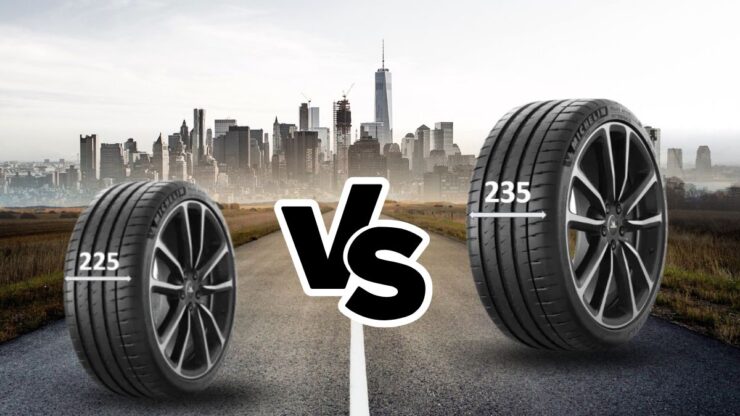
A 235 tire has a wider contact patch than a 225 tire. This means more rubber touches the road. A wider tire can offer better grip, especially during cornering or on wet roads. However, it can also create more rolling resistance, which may reduce fuel efficiency.
Sidewall Height
If both tires have the same aspect ratio (like 45), the sidewall on the 235 tire will be slightly taller. This can affect the ride quality. Taller sidewalls may absorb bumps better, making the ride softer.
Weight And Performance
Wider tires like 235 are usually heavier. Extra weight can change acceleration and braking. Sometimes, wider tires also slow down steering response. Narrower tires, like 225, can feel lighter and more agile.
Aesthetic Differences
Many car owners choose wider tires for the look. 235 tires often fill the wheel arch better, giving a sportier appearance. 225 tires may look slimmer, which some people prefer for a clean style.
Compatibility: Can You Swap 225 For 235 Tires?
Wheel Width Matters
Your wheel must fit the tire. Most wheels that fit a 235 tire will also fit a 225 tire. But check the wheel width. For example, a wheel that is 7.5 inches wide can usually fit both sizes, but a very narrow wheel may not fit a 235 tire.
Vehicle Requirements
Check your car’s manual or the placard on the door. Manufacturers test tires for safety and performance. Using a different size than recommended can affect speedometer accuracy, handling, and safety systems.
Speedometer Impact
Changing tire size affects the speedometer. If you use a 225 tire instead of a 235, your speedometer may show a slightly higher speed than your actual speed. This is because the overall diameter of the tire changes.
Clearance And Suspension
Wider tires can rub against the suspension or wheel arch. If you switch from a 235 tire to a 225 tire, this problem is less likely. But always check for enough clearance.
Performance: How Does Tire Size Affect Driving?
Handling
Wider tires (235) offer more grip. This is helpful for sporty driving or high-speed cornering. Narrower tires (225) can be easier to steer and may reduce effort for everyday driving.
Comfort
Tires with taller sidewalls (like some 235 tires) absorb road bumps better. However, if both tires have the same aspect ratio, the difference is small.
Fuel Efficiency
Narrower tires usually have less rolling resistance. Switching to 225 tires may improve your fuel economy slightly, though the change is not dramatic.
Braking
Wider tires provide more surface area, which can help with braking. The difference between 225 and 235 is small, but for heavy vehicles or high speeds, wider tires may stop faster.
Credit: www.subaruoutback.org
When Should You Consider Using 225 Tires Instead Of 235?
- Cost Savings: Sometimes, 225 tires are cheaper than 235 tires. If you are on a budget, this could be a reason to switch.
- Better Fuel Efficiency: If you drive long distances and want to save fuel, the narrower tire can help.
- Less Tire Noise: Narrower tires often create less noise, making your drive quieter.
- Winter Driving: In snow, narrower tires cut through the snow better. If you live in snowy areas, 225 tires can improve traction.
- Fit Issues: If your wheels or car suspension have clearance problems, a narrower tire may solve the issue.
Risks And Common Mistakes When Swapping Tire Sizes
Ignoring Manufacturer’s Recommendations
Always check your car manual before changing tire size. Manufacturers test tires for safety and performance. Using a different size can affect ABS and traction control.
Not Adjusting For Aspect Ratio
If you change the width, also check the aspect ratio. Keeping the same aspect ratio may not keep the overall tire diameter the same. This can affect speedometer and odometer readings.
Not Checking Load Rating
Each tire has a load rating. Make sure your new 225 tire can support the weight of your vehicle. Using tires with lower load ratings can cause tire failure.
Mixing Tire Sizes
Do not mix 225 tires with 235 tires on the same axle. This can cause unsafe handling and uneven wear.
Practical Example: Comparing Tire Specifications
Here is a comparison of 225/45R17 and 235/45R17 tires:
| Tire Size | Width (mm) | Sidewall Height (mm) | Overall Diameter (mm) | Contact Patch |
|---|---|---|---|---|
| 225/45R17 | 225 | 101.25 | 634.9 | Smaller |
| 235/45R17 | 235 | 105.75 | 642.3 | Larger |
The 235/45R17 tire is about 7.4 mm larger in diameter and has a wider contact patch.
Real-world Data: Impact On Fuel Economy
According to tire tests, switching from 235 to 225 tires can improve fuel economy by up to 2%. For example, a car that gets 30 mpg with 235 tires might get about 30.6 mpg with 225 tires. The improvement is small but noticeable over long distances.
Step-by-step Guide: How To Change Tire Size Safely
- Check Your Owner’s Manual for recommended tire sizes.
- Inspect Wheel Width to make sure the new tire fits.
- Compare Load Ratings to keep safety high.
- Check Clearance for suspension and fenders.
- Adjust Aspect Ratio if needed to keep tire diameter similar.
- Install Matching Tires on all wheels for best performance.
- Update Speedometer Calibration if diameter changes a lot.
- Test Drive to check handling and comfort.
Non-obvious Insights Most Beginners Miss
- Tire Pressure May Change: When switching sizes, recommended tire pressure can change. Always check the new tire’s specs.
- Insurance and Warranty Issues: Some insurers may not cover vehicles with non-standard tires. Changing sizes can also affect warranty coverage.
Comparison Table: 225 Vs 235 Tire Pros And Cons
| Feature | 225 Tire | 235 Tire |
|---|---|---|
| Grip | Good | Better |
| Fuel Economy | Better | Lower |
| Cost | Lower | Higher |
| Comfort | Similar | Slightly better |
| Noise | Lower | Higher |
| Aesthetics | Clean | Sporty |
How Tire Size Affects Safety Features
Modern cars use systems like ABS and traction control. Tire size can change the effectiveness of these systems. The computer expects a certain tire size. If you change it, the system may not work as designed. Always check with your dealer or a tire professional before making changes.
Credit: www.tireryder.com
Legal And Insurance Considerations
Some countries or states require you to use manufacturer-recommended tire sizes. Using a different size can affect your insurance coverage. If you have an accident, the insurer may check if your tires are correct. For more details, see Tire Rack Guide.
Frequently Asked Questions
Can I Use 225 Tires Instead Of 235 On The Same Wheels?
Yes, in most cases, 225 tires will fit on wheels designed for 235 tires. Check the wheel width range and your vehicle’s recommendations before changing.
Will Changing From 235 To 225 Tires Affect My Speedometer?
Yes, your speedometer may show a slightly higher speed than your actual speed. The difference is small but can be important for accurate driving.
Are 225 Tires Better For Fuel Economy Than 235 Tires?
Yes, 225 tires often have less rolling resistance, which can improve fuel economy. The improvement is usually around 2%.
Will 225 Tires Give Me Less Grip Than 235 Tires?
Yes, 235 tires have a wider contact patch and usually offer better grip, especially in sporty driving or wet conditions.
Is It Safe To Mix 225 And 235 Tires On The Same Car?
No, it is not safe to mix tire sizes on the same axle. This can cause unstable handling and uneven tire wear.
Swapping tire sizes is a big decision. Knowing the differences between 225 and 235 tires helps you make a smart choice. Always check your car’s requirements and talk to a tire expert if you are unsure. Changing tires can affect handling, safety, comfort, and even insurance. If you follow the steps above, you can make a safe switch and enjoy the benefits of your new tires.

Credit: www.youtube.com