Checking your tire pressure in a Honda CR-V may seem simple, but it’s a key part of safe driving and saving money. Many drivers ignore their tires until they look flat or the warning light comes on. But even a small drop in pressure can affect your car’s handling, fuel economy, and tire life. In fact, the U.S. Department of Energy says that keeping your tires at the right pressure can improve gas mileage by up to 3%. For a popular car like the Honda CR-V, which families and commuters trust every day, knowing how to check tire pressure correctly is essential.
This guide will show you every step, from understanding tire pressure basics to using the right tools. You’ll learn what numbers matter, how to find them, and how weather can change your readings. There are also tips to avoid common mistakes, plus answers to questions many CR-V owners have.
Whether you’re a new driver or just want to protect your investment, this article will give you the confidence to check your tire pressure the right way.
Why Tire Pressure Matters In A Honda Cr-v
Tire pressure does more than keep your CR-V running smoothly. It affects how your car brakes, turns, and handles rough roads. If your tires are underinflated, they create more friction, which means the engine has to work harder. This can lower your gas mileage, make tires wear out faster, and even cause blowouts on the highway. Overinflated tires, on the other hand, don’t grip the road well and can lead to a rough, bouncy ride.
For the Honda CR-V, correct tire pressure also makes the advanced safety systems—like anti-lock brakes and traction control—work their best. It’s not just about comfort; it’s about keeping you, your passengers, and your car safe.
What You Need To Check Tire Pressure
You don’t need fancy gadgets to get started. Most people can check their CR-V’s tires with just a few simple tools:
- Tire pressure gauge (digital or analog)
- Air compressor or access to air at a gas station
- Owner’s manual or tire information sticker (usually found on the driver’s door jamb)
Digital gauges are easy to read and very accurate, while analog (pencil-type) gauges are cheap and reliable. If you prefer, many auto parts stores can check your pressure for free, but knowing how to do it yourself is more convenient.
Credit: techinfo.honda.com
Finding The Correct Tire Pressure For Your Cr-v
Honda does not use the same tire pressure for every model or tire size. Using the wrong pressure can cause problems. The exact number is called the manufacturer’s recommended pressure.
Where To Find The Right Pressure
Check these spots for the official number:
- Driver’s door jamb: Open the driver’s door and look for a sticker near the latch. It lists front and rear tire pressure (in PSI, pounds per square inch).
- Owner’s manual: The specifications section will give you the numbers for original tires.
- Fuel door: Some models place a sticker here.
Do not use the number printed on the tire’s sidewall—that’s the maximum the tire can hold, not what’s best for your CR-V.
Common Honda Cr-v Tire Pressures
Here’s a quick look at typical pressures for recent Honda CR-Vs:
| Model Year | Front Tires (PSI) | Rear Tires (PSI) | Spare Tire (PSI) |
|---|---|---|---|
| 2017-2024 | 32 | 32 | 60 (temporary spare) |
| 2012-2016 | 30 | 30 | 60 (temporary spare) |
| 2007-2011 | 30 | 30 | 60 (temporary spare) |
Always double-check for your exact trim and tire size.
How To Check Tire Pressure: Step-by-step
Doing this the right way only takes a few minutes. Here’s how to get the most accurate results.
1. Make Sure Tires Are Cold
Tire pressure changes as you drive. Heat from the road and friction can raise the pressure by 2-5 PSI. For the most accurate reading, check your tires when the car has been parked for at least three hours or before you’ve driven more than a mile.
2. Remove The Valve Cap
Each tire has a small black or silver cap on the valve stem. Turn it counterclockwise to remove it. Don’t lose the cap—it keeps dirt and moisture out.
3. Press The Gauge Firmly
Place your gauge onto the valve stem. Press down quickly and evenly. If you hear a short “pssst” of air, that’s normal. If you hear a long hiss, the gauge isn’t sealed—try again until you get a steady reading.
4. Read The Pressure
- Digital gauges: Show the number instantly.
- Analog gauges: The stick pops out to a number, or the needle points to the pressure.
Write down the number if you’re checking all four tires.
5. Adjust The Pressure
If the pressure is too low, add air using a compressor. If it’s too high, press the small pin inside the valve stem to release air in short bursts, then recheck.
6. Replace The Valve Cap
When you’re done, screw the cap back on tightly.
Repeat these steps for all four tires and the spare if your CR-V has a full-size one.
Credit: techinfo.honda.com
How Often Should You Check Tire Pressure?
Honda and safety experts recommend checking at least once a month and before long trips. Tires can lose 1-2 PSI per month naturally, even without leaks. Cold weather, long drives, and big temperature swings can make the pressure drop even faster.
Understanding Your Honda Cr-v’s Tire Pressure Monitoring System (tpms)
Most modern CR-Vs have a Tire Pressure Monitoring System that warns you if a tire is too low. But TPMS is not a replacement for manual checks.
How Tpms Works
There are two main types in the Honda CR-V:
- Direct TPMS: Sensors inside the wheel measure the pressure and send data to the dashboard.
- Indirect TPMS: Uses the car’s ABS system to sense if a tire is spinning differently, which may mean low pressure.
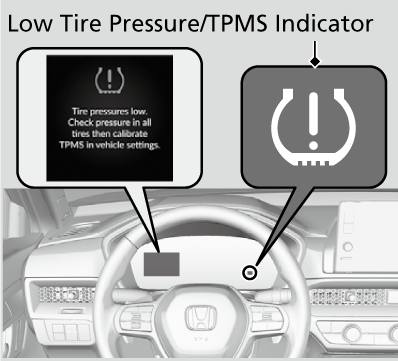
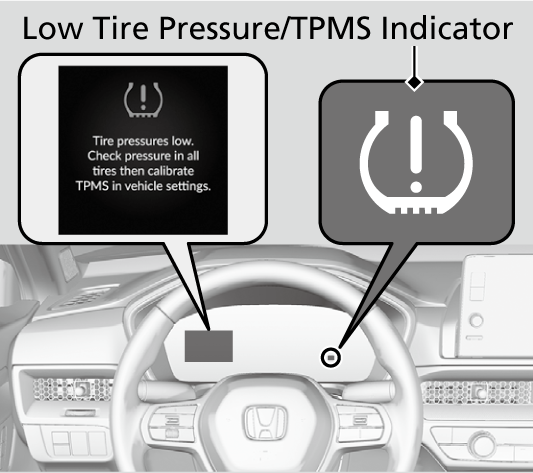
If the TPMS warning light comes on (it looks like an exclamation point inside a horseshoe), stop and check your tires as soon as possible. TPMS usually warns you when a tire is about 25% underinflated, which can already be unsafe.
Resetting Tpms After Adjusting Pressure
Sometimes the TPMS light stays on after you add air. For most CR-V models:
- Drive above 28 mph for 10-30 minutes so the system can reset.
- Some models have a TPMS reset button under the dashboard or in the settings menu. Follow your owner’s manual for details.
Weather And Tire Pressure: What Cr-v Owners Need To Know
Temperature changes have a big effect on tire pressure. For every 10°F (5. 5°C) drop, your tires can lose about 1 PSI. In winter, it’s common for the TPMS light to come on in the morning, then turn off as you drive and the tires warm up.
If you fill your tires on a warm day, check them again when it gets cold. If you move between hot and cold climates, adjust your pressure as soon as you arrive.
Common Mistakes When Checking Tire Pressure
Many CR-V owners make simple mistakes that can lead to wrong readings or tire problems.
- Checking after driving: Wait until tires are cold for accuracy.
- Ignoring the spare tire: Temporary spares need much higher pressure (often 60 PSI).
- Trusting the TPMS only: Manual checks are more precise.
- Using the wrong gauge: Cheap gauges can be off by several PSI—replace old ones.
- Using the maximum pressure on the tire sidewall: Always follow Honda’s recommendation, not the tire’s limit.
- Not replacing valve caps: Missing caps let in dirt and water, which can cause leaks.
Here’s a quick comparison to make things clearer:
| Good Practice | Common Mistake |
|---|---|
| Check when tires are cold | Check after driving |
| Use Honda’s recommended PSI | Use tire sidewall maximum |
| Manual check plus TPMS | Rely on TPMS only |
Special Tips For New Honda Cr-v Owners
- Buy a good quality gauge—digital ones are easy to use.
- Keep a small notebook in your glove box to log monthly readings.
- If you rotate your tires or change the size, update your check routine.
- Always check tire pressure before trips with heavy loads or when towing.
- If you drive on gravel or rough roads, check pressure more often, as impacts can cause slow leaks.
What To Do If Your Tire Pressure Is Always Low
If you keep losing air, even after filling up, it’s time for a closer look:
- Inspect for nails, screws, or glass stuck in the tire.
- Check the valve stem for cracks or leaks.
- Spray soapy water on the tire and watch for bubbles (a sign of a slow leak).
- Visit a tire shop for a professional inspection—they may find a hidden puncture or a bent wheel.
Driving with a slow leak is dangerous and can damage your tire beyond repair. If you’re unsure, get help quickly.

Credit: www.youtube.com
How Tire Pressure Affects Fuel Economy And Tire Life
Properly inflated tires roll more easily, which means your engine uses less fuel. According to the U.S. Department of Energy, underinflated tires can lower gas mileage by 0.2% for every 1 PSI drop in pressure.
Over the life of your CR-V, keeping tires at the right pressure can:
- Save you hundreds of dollars in fuel costs
- Add thousands of miles to your tire’s life
- Reduce your risk of blowouts and skidding
Here’s how underinflation affects your CR-V’s performance:
| PSI Below Recommended | Possible Effects |
|---|---|
| 1-2 PSI | Slight drop in fuel economy, minor tire wear |
| 5 PSI | Noticeable handling issues, faster tire wear, lower fuel economy |
| 10+ PSI | High blowout risk, very poor handling, tire damage |
Non-obvious Insights Most Cr-v Owners Miss
- Seasonal tire changes: If you switch between all-season and winter tires, they may require different pressures. Always check after swapping tires.
- Altitude changes: If you drive to a higher elevation, air pressure outside drops, but your tires’ pressure can increase slightly. If you move from low to high altitudes, check and adjust once you arrive.
Frequently Asked Questions
Why Does My Cr-v’s Tpms Light Turn On In The Morning But Off Later In The Day?
This usually happens in cold weather. When tires are cold, the pressure drops. As you drive, the tires warm up, and the pressure rises again, which can turn the light off. Always check your tires when cold to get an accurate reading.
What Is The Recommended Tire Pressure For A 2022 Honda Cr-v?
For most 2022 Honda CR-Vs, the recommended pressure is 32 PSI for both front and rear tires. But always check the sticker on your driver’s door or your owner’s manual for your exact model and tire size.
Can I Use Nitrogen Instead Of Air In My Cr-v’s Tires?
Yes, you can fill your Honda CR-V’s tires with nitrogen. Nitrogen leaks out slower than regular air and is less affected by temperature swings, but it’s not essential. If you need to top up and only have air, it’s fine to mix them.
How Do I Reset The Tpms After Correcting Tire Pressure?
Drive your CR-V at speeds over 28 mph for about 10-30 minutes. The system usually resets itself. If not, check your manual for the reset procedure, which may involve a button or the touchscreen menu.
Where Can I Find More Information On Tire Safety?
For more on tire safety and maintenance, visit the National Highway Traffic Safety Administration.
Checking your Honda CR-V’s tire pressure is one of the easiest ways to keep your car safe, efficient, and comfortable. With a few minutes each month and the right habits, you can avoid problems and enjoy a smoother ride for years to come.
Take charge of your car’s health—your tires (and wallet) will thank you.