Choosing what to fill your tires with—air or nitrogen—seems like a small detail. Yet, this choice can impact your car’s performance, safety, and even your wallet. Many drivers see tire inflation as a simple task, but there’s more happening inside those rubber walls than meets the eye. Understanding the differences between air and nitrogen, how they behave, and what they offer will help you make the best decision for your driving habits and needs.
Let’s dive deep into the science, the claims, and the real-world facts about using air versus nitrogen in your tires. Whether you’re a daily commuter, a weekend traveler, or a car enthusiast, this guide will give you the full picture—without jargon or confusion.
What’s Inside The Tires: Air And Nitrogen Explained
Most people think of tire air as just “air,” but it’s actually a mix of gases. Regular compressed air is about 78% nitrogen, 21% oxygen, and 1% other gases such as carbon dioxide and water vapor. Nitrogen inflation means using nearly pure nitrogen (often 93–99%) instead of this mix. But why does it matter?
The idea behind filling tires with nitrogen comes from racing and aviation. In these fields, small differences in tire pressure and temperature can affect performance or safety. Let’s break down what makes air and nitrogen different:
- Regular Air: Contains moisture and a mix of gases. It’s cheap and everywhere.
- Nitrogen: Dry and pure, with less chance of pressure changes due to temperature or moisture.
One non-obvious fact: Even with nitrogen inflation, your tire will never be 100% nitrogen. Small leaks, mounting, and natural diffusion introduce some air over time.
The Science Behind Tire Pressure And Gas Behavior
Understanding tire gases means knowing how they react to temperature, pressure, and rubber. The main scientific principle at play is gas diffusion—how quickly gas molecules escape through the tire’s rubber.
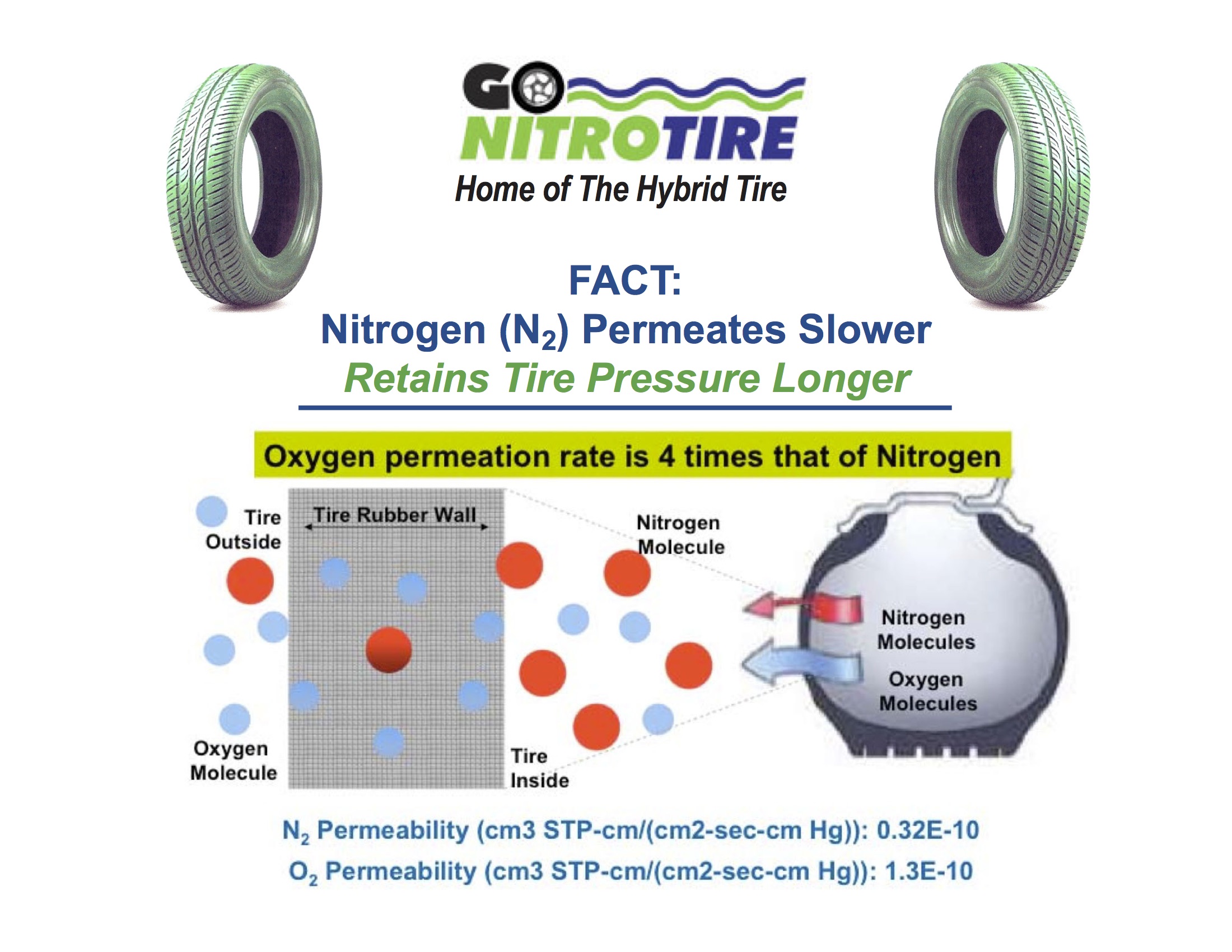
- Nitrogen molecules are slightly larger than oxygen molecules. This means nitrogen escapes more slowly, so your tires may hold pressure longer.
- Oxygen and moisture in air can cause oxidation. This can slowly break down the rubber and corrode the steel parts inside a tire.
Temperature also plays a role. All gases expand when heated and contract when cooled. But dry nitrogen is more stable, so tire pressure changes are smaller with temperature shifts.
One insight many miss: The biggest pressure changes come from moisture in the air, not just the type of gas. Drying the air before filling helps almost as much as switching to nitrogen.
Key Benefits Of Air In Tires
For decades, air has been the go-to for inflating tires. Here’s why:
- Cost-effective and accessible: Air is free (or very cheap) at most gas stations.
- Simple to refill: You can top up anywhere, anytime, with any air compressor.
- Adequate for most drivers: For regular city and highway driving, air works well and meets car manufacturers’ recommendations.
But there are also some drawbacks:
- Pressure loss: Air leaks out a bit faster than nitrogen, so you may have to check and refill more often.
- Moisture content: Air usually contains water vapor, which can cause more pressure changes and possibly rust steel rims over time.
Still, for most people, the convenience and low cost of air outweigh these minor issues.
Key Benefits Of Nitrogen In Tires
Nitrogen inflation is growing in popularity, especially in high-performance and commercial vehicles. Here’s what it offers:
- Slower pressure loss: Nitrogen leaks out up to 40% slower than regular air. This means more stable tire pressure over time.
- Less moisture: Nitrogen is dry, reducing the risk of internal corrosion and oxidation.
- Smaller pressure changes: Nitrogen’s purity means tire pressure changes less with temperature swings—a big plus for racing, trucking, or flying.
- Longer tire life: Less oxidation and better pressure can mean your tires last longer.
However, it’s not all upside. Nitrogen inflation:
- Costs more: Filling with nitrogen can cost $5–$10 per tire, sometimes more.
- Is less available: Not all shops offer nitrogen, especially in remote areas.
- Is not magic: The benefits are real, but not dramatic for most everyday drivers.
A key insight: Nitrogen is most useful if you need high precision (racing, aircraft) or if you hate checking tire pressure. For regular drivers, the extra cost may not pay off.
Comparing Air And Nitrogen: A Side-by-side Look
To help you see the practical differences, here’s a direct comparison of the two:
| Feature | Air | Nitrogen |
|---|---|---|
| Pressure retention | Good, but loses a bit faster | Better, holds pressure longer |
| Availability | Everywhere | Limited locations |
| Cost | Usually free or cheap | $5–$10 per tire, sometimes more |
| Effect on tire life | Standard | Potentially longer (less oxidation) |
| Moisture content | High (can cause rim rust) | Very low (dry gas) |
| Pressure change with temperature | Moderate | Less (more stable) |
Real-world Performance: What The Data Says
Studies show that nitrogen-filled tires lose pressure about 1. 3 PSI less per year compared to air-filled ones. That’s a modest difference, but it can matter over time, especially if you forget to check your tires.
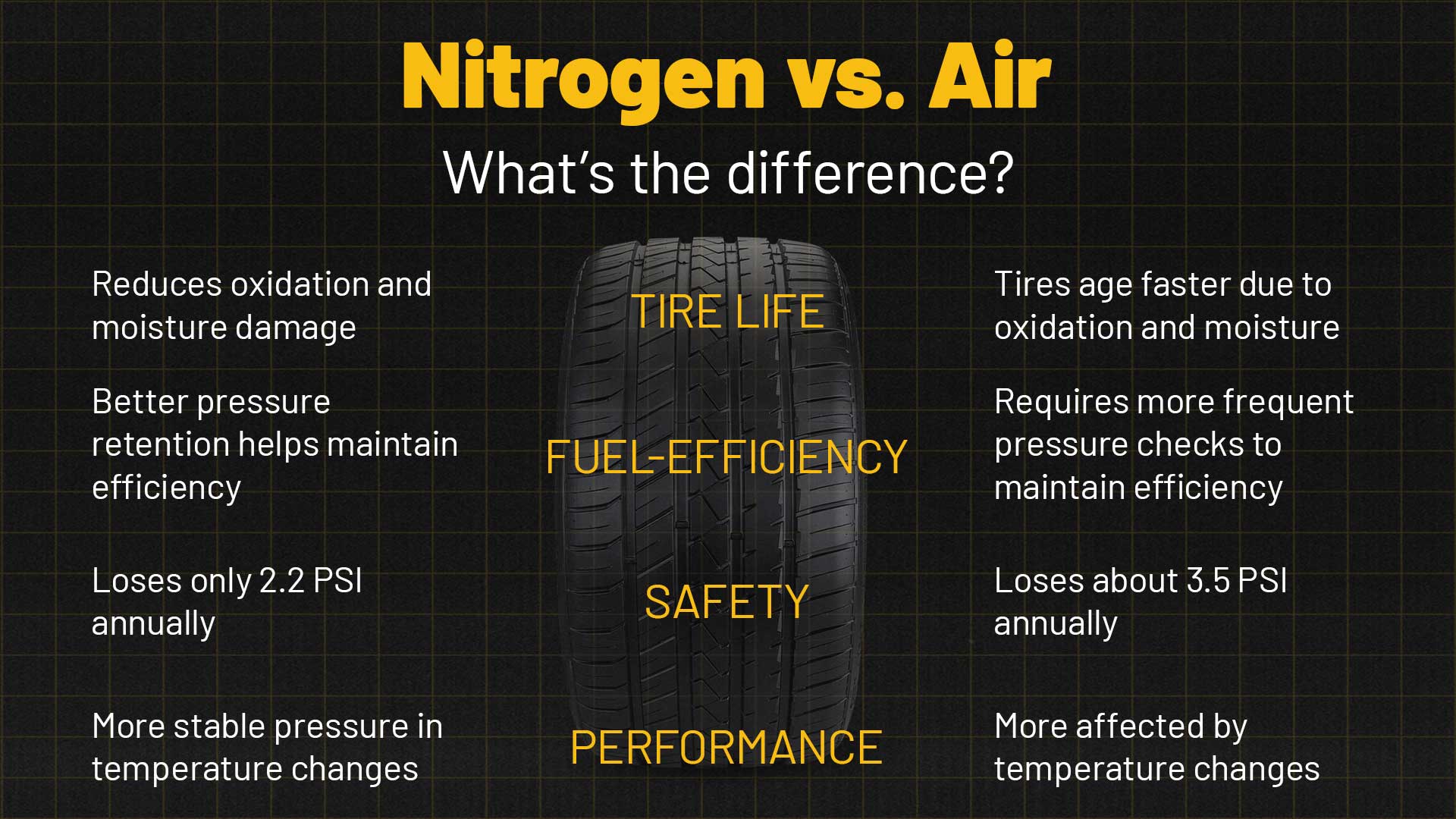
In one test by Consumer Reports, cars drove for one year with both air- and nitrogen-filled tires. After a year, air-filled tires lost about 3. 5 PSI on average, while nitrogen-filled tires lost about 2. 2 PSI. That’s only a slight advantage, but it’s measurable.
Another point: Racing teams and airlines use nitrogen not just for pressure stability but because dry nitrogen almost eliminates the risk of water vapor freezing at high altitude or high speed.
It’s important to note that for most daily drivers, these differences won’t be felt in normal city or highway use. Proper tire maintenance—checking pressure monthly and rotating tires—is far more important than what gas you use.
Credit: www.gonitrotire.com
Impact On Fuel Economy And Safety
Tire pressure has a direct effect on fuel economy and safety. Under-inflated tires can lower your miles per gallon (MPG) by 0.2% for every 1 PSI drop. They can also cause tires to overheat, which sometimes leads to blowouts.
Because nitrogen holds pressure a bit longer, you might see slightly better fuel economy—if you tend to ignore checking your tires. But if you check and refill regularly, the difference is almost zero.
A non-obvious point: Most fuel loss and safety problems come from severe under-inflation (more than 10%). Both air and nitrogen are safe if you keep tires at the right pressure.
Environmental Considerations
Some believe nitrogen is better for the environment. The logic: longer tire life means fewer old tires in landfills, and stable pressure means better fuel economy, so less CO2.
But in reality, the environmental impact of switching to nitrogen is small for most drivers. The biggest gains come from keeping your tires properly inflated—no matter what’s inside.
It’s also worth noting that producing and distributing nitrogen takes energy. The greenest approach is to check your tire pressure often, drive smoothly, and replace tires only when needed.
When Should You Use Nitrogen?
There are cases where nitrogen makes sense:
- High-performance driving: Racing cars, high-speed track days, or autocross events where small changes in pressure affect grip and handling.
- Commercial fleets: Trucks, buses, and taxis that log lots of miles and benefit from longer intervals between refills.
- Aviation: Aircraft tires use nitrogen because temperature and pressure changes are extreme, and safety is critical.
- Long-term storage: If you store vehicles for months, nitrogen can reduce flat spots and corrosion.
But for most passenger cars, using regular air and checking pressure monthly is just as effective.
Common Myths And Misconceptions
There’s a lot of marketing around nitrogen tires. Let’s clear up a few common myths:
- Myth: Nitrogen won’t leak at all. Fact: Nitrogen leaks slower, but tires are not airtight. All tires lose pressure over time.
- Myth: Nitrogen will double tire life. Fact: It may add some months, but proper inflation and rotation matter far more.
- Myth: You can’t mix air and nitrogen. Fact: You can top up nitrogen-filled tires with air if needed. Purity will drop, but it won’t harm your tires.
A practical insight: If you start with nitrogen but add air later, you lose some benefits, but your tires remain safe and functional.
The Cost Factor: Is Nitrogen Worth The Price?
Cost is a big factor for many drivers. Nitrogen inflation can range from $5 to $10 per tire at shops, and sometimes it’s even higher. Over a set of four tires, that adds up fast.
Let’s compare costs in a simple way:
| Service | Air | Nitrogen |
|---|---|---|
| Initial inflation | Free or $1–$2 | $20–$40 for four tires |
| Refills | Usually free | $5–$10 per visit |
| Annual total (4 refills) | $0–$8 | $40–$80 |
If you’re a taxi driver or manage a fleet, the small savings in tire life or fuel might make up for this cost. For most everyday drivers, the benefits are too small to justify the extra spending.
Tire Maintenance: What Matters Most
Choosing air or nitrogen is less important than following these simple tire care steps:
- Check tire pressure every month. Use a good gauge, and do it when tires are cold.
- Rotate your tires every 5,000–8,000 miles. This keeps wear even and improves lifespan.
- Inspect for damage and tread depth. Replace tires before the tread is too low.
- Fix leaks promptly. Even a slow leak can ruin a tire or rim over time.
No matter what gas you use, good maintenance will always bring the biggest benefits.
Credit: lionharttires.com
Who Should Stick With Regular Air?
For the vast majority of drivers, regular air is the best choice. It’s free, easy to access, and safe. If you:
- Drive mostly in the city or on highways
- Check tire pressure monthly
- Don’t want to pay extra for small benefits
Then regular air will serve you well. Focus on maintenance, not the gas.
Who Might Benefit From Nitrogen?
Nitrogen is most useful for:
- Race car drivers or track enthusiasts
- Owners of expensive sports cars who want every edge
- Commercial drivers who want fewer refills and less downtime
- Anyone storing a car for long periods
If you fit these categories, nitrogen may be worth a try. But remember, it’s not a substitute for regular checks and care.
Practical Tips For Switching To Nitrogen
If you decide to switch your tires to nitrogen, here’s how to do it right:
- Find a reputable shop. Not all nitrogen is equally pure. Look for a shop that offers at least 93% purity.
- Purge old air. To get as much nitrogen inside as possible, the shop should inflate and deflate your tires several times.
- Label your tires. Some shops add green valve caps or stickers to show you’re using nitrogen.
- Don’t worry if you add air later. It won’t damage your tires, but tell your shop next time for a top-up.
A tip many miss: Purity matters most at the start. After a few air top-ups, the benefit drops. But your tires remain safe.
What Experts And Car Makers Recommend
Most car manufacturers do not require nitrogen. They recommend keeping tires at the right pressure, no matter what gas you use. Some luxury brands offer nitrogen as an option, but it’s rarely a must.
Organizations like the National Highway Traffic Safety Administration (NHTSA) say that both air and nitrogen are safe, as long as you maintain the correct pressure.
For more on the science, visit the Wikipedia: Nitrogen tire inflation page.
Credit: www.springfieldacura.com
The Bottom Line: Making The Right Choice
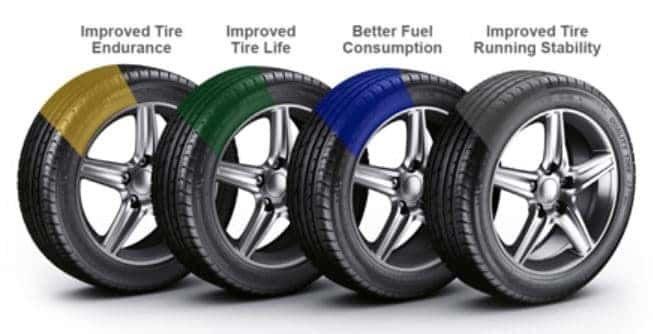
Air and nitrogen both have a place in tire care. Nitrogen offers small advantages in pressure stability, moisture reduction, and tire life. These benefits are most noticeable in racing, commercial driving, or long-term storage.
For most drivers, regular air and proper maintenance are enough. The real key is not what you fill your tires with, but how you care for them. Check your pressure every month, rotate your tires, and fix problems early.
Don’t get caught up in marketing hype. Make your choice based on your driving style, budget, and willingness to check your tires. Either way, good tire care will keep you safer and help your tires last longer.
Frequently Asked Questions
Is Nitrogen Really Better Than Air For Everyday Driving?
For most drivers, nitrogen and air work almost the same. Nitrogen holds pressure a bit longer and reduces moisture, but the difference is small for everyday use. Good tire care matters more than the type of gas.
Can I Mix Air And Nitrogen In My Tires?
Yes, you can mix air and nitrogen safely. If you add air to a nitrogen-filled tire, you lose some benefits, but it’s not dangerous. Your tire will still perform well.
Does Nitrogen Improve Fuel Economy?
Nitrogen can help maintain correct tire pressure longer, which is good for fuel economy. But if you check your pressure monthly, air and nitrogen give almost the same results.
Why Do Race Cars And Airplanes Use Nitrogen?
Race cars and airplanes use nitrogen because it’s dry and stable. This gives more consistent pressure, especially during extreme temperature changes. It’s critical for high-speed safety and performance.
Is It Worth Paying Extra For Nitrogen Inflation?
For most people, paying extra for nitrogen isn’t needed. The benefits are small for normal driving. If you want the longest tire life and least maintenance, nitrogen helps a bit—but regular air with good care is just as safe and effective.