Choosing the right tire pressure gauge is more important than many drivers realize. Accurate tire pressure is not just about keeping your ride smooth; it’s a matter of safety, fuel economy, and even the life of your tires. Today, you’ll find two main types of gauges: digital and analog. Each comes with clear benefits and a few drawbacks, and the choice is not as obvious as it seems. Whether you’re a car owner, a biking enthusiast, or someone responsible for fleet maintenance, knowing the difference can save you money and prevent unexpected problems on the road.
Let’s dive into the details of digital vs analog tire pressure gauges, exploring how they work, where they shine, and which one might be better for your needs. Along the way, we’ll tackle common myths, show real-world examples, and highlight what most beginners miss when making their choice.
What Is A Tire Pressure Gauge?
A tire pressure gauge is a tool for measuring the air pressure inside a tire. It’s a small device, but the information it gives is critical. Tires that are too soft or too hard can lead to poor handling, lower fuel efficiency, and even blowouts. Proper tire pressure means safer driving, longer-lasting tires, and better gas mileage.
There are two main types:
- Analog tire pressure gauges (also called mechanical or dial gauges)
- Digital tire pressure gauges
Let’s look closer at how each type works.
How Does An Analog Tire Pressure Gauge Work?
Analog tire pressure gauges have been around for decades. They work using physical parts—no batteries, no screens. The most common analog gauges are pencil-style or dial-style.
When you press the gauge onto your tire’s valve stem, air pushes against a spring or a tube inside the gauge. This force moves a needle (in dial gauges) or a sliding rod (in pencil gauges) to show you the pressure.
Advantages of analog gauges:
- No batteries needed: They always work, no matter where you are.
- Durable design: Fewer electronic parts mean less that can break.
- Affordable: Often cheaper than digital models.
Drawbacks:
- Harder to read: Small numbers and needles can be tricky, especially in low light.
- Slightly less precise: Needle movement can be affected by shaking hands or tiny mechanical errors.
- No extra features: You get the pressure reading, nothing more.

Credit: aochenggroup.com
How Does A Digital Tire Pressure Gauge Work?
Digital tire pressure gauges use electronic sensors to measure air pressure. When you press the device onto your tire, it senses the pressure and displays the result on an LCD screen.
Advantages of digital gauges:
- Easy to read: Large, backlit screens show the number clearly, even at night.
- Precise: Digital sensors often offer readings down to a tenth of a PSI.
- Extra features: Some models include flashlight, memory, or even Bluetooth connectivity.
Drawbacks:
- Needs batteries: If the battery is dead, the gauge won’t work.
- Can be less durable: Sensitive electronics may not survive drops or water as well as analog gauges.
- Usually costs more: The added tech means a higher price tag.
Key Differences Between Digital And Analog Gauges
Let’s break down the main points that separate these two types. The following table compares their main features for a quick overview:
| Feature | Analog Gauge | Digital Gauge |
|---|---|---|
| Power Source | None (Mechanical) | Batteries (Electronic) |
| Readability | Needle/Dial, can be hard to see | Large digital display |
| Accuracy | Good, but can drift over time | High, stays consistent |
| Durability | Very high | Depends on build, sensitive to drops |
| Features | Simple, just shows pressure | May include backlight, memory, etc. |
| Price | Usually cheaper | Usually more expensive |
Accuracy: Which Gauge Is More Trustworthy?
Both analog and digital gauges can be accurate, but there are a few things to consider.
- Digital gauges are usually more precise. They can show pressure in tenths (like 32.5 PSI), while analog dials may only show whole numbers.
- Analog gauges can lose accuracy if dropped or if their springs wear out. Over time, the needle might not rest at zero, causing small errors.
- Calibration matters for both. A high-quality analog gauge can be just as accurate as a digital one if it’s well made and not damaged.
Non-obvious insight: Many beginners believe a new gauge is always accurate. In reality, both types can be slightly off, especially after a few years. It’s smart to check your gauge’s accuracy once a year, especially if you notice strange readings.
Durability And Reliability
Analog gauges are famous for their toughness. There’s not much that can go wrong unless you physically damage the moving parts. They can work for decades, even after being tossed in a glove box or toolbox.
Digital gauges, however, have electronic parts that can be sensitive to moisture, extreme temperatures, or rough handling. Some high-end models are built to be tough (with rubber covers or waterproofing), but many standard models need careful use.
Practical tip: If you plan to keep the gauge in your car all year—especially in a hot or cold climate—analog may last longer. Digital models left in extreme heat can have battery leaks or screen issues.
Readability And User Experience
This is where digital gauges usually win. The digital display is easy to see, even in poor lighting. Many digital gauges have a backlight or glow-in-the-dark screens. This is a big help if you need to check your tires at night or in a dark garage.
Analog gauges require you to look closely at the dial or rod. If your eyesight isn’t perfect, or if you’re in a hurry, it’s easy to misread the number. This can lead to over- or under-inflating your tires.
Real-world example: Imagine checking your tire pressure at a gas station at night in the rain. With a digital gauge, you’ll see the numbers instantly. With an analog gauge, you may need a flashlight or squint to read the dial correctly.
Common Features: Digital Vs Analog
While analog gauges are simple, digital models may pack in extra features. Here are some you might find in digital gauges:
- Auto shut-off: Saves battery life if you forget to turn it off.
- Backlit screens: For night or low-light use.
- Multiple units: Switch between PSI, Bar, kPa, or kg/cm².
- Memory function: Stores the last reading for later.
- Flashlight: Built-in light for finding the valve at night.
- Bluetooth: Sends readings to your phone (premium models).
Analog gauges rarely have these extras. Their advantage is in simplicity—what you see is what you get.
Price Comparison
Cost is a big factor for many buyers. Analog gauges often start as low as $5–$10 for basic pencil or dial models. High-end analog gauges with protective cases or hoses may cost $20–$30.
Digital gauges start around $10–$15 for basic models, and can go up to $50 or more for advanced versions with Bluetooth or heavy-duty builds.
The following table shows typical price ranges:
| Type | Low-End Price | High-End Price | Features at High-End |
|---|---|---|---|
| Analog | $5 | $30 | Protective case, long hose, glow dial |
| Digital | $10 | $50+ | Backlight, Bluetooth, multi-unit, flashlight |
Non-obvious insight: Cheaper digital gauges may not last as long as mid-range analog models, so price alone doesn’t tell the whole story. Sometimes, paying a bit more for durability or extra features pays off in the long run.
When To Choose A Digital Tire Pressure Gauge
Digital gauges are the right choice if:
- You want precise readings (such as for motorcycles, performance cars, or bicycles)
- You often check tires in low light or at night
- You prefer easy-to-read numbers, especially if your eyesight isn’t perfect
- You want extra features like memory or Bluetooth
They’re also helpful if you need to switch between units (PSI, Bar, kPa). For example, if you travel to countries that use different units, a digital gauge makes things simple.
Example: A car enthusiast who fine-tunes tire pressure for track days will appreciate the accuracy and instant readings of a good digital gauge.
When To Choose An Analog Tire Pressure Gauge
Analog gauges are best if:
- You want maximum durability (for glove box, toolbox, or rough environments)
- You don’t want to worry about dead batteries
- You prefer a simple tool with no extra buttons or menus
- You’re on a tight budget
They’re great for trucks, off-road vehicles, or anyone who values reliability over extra features.
Example: Someone who works in construction and keeps a gauge in their truck will benefit from the tough build and always-ready nature of an analog gauge.
Pros And Cons Summary
Here’s a brief summary of the main pros and cons of each type:
Analog Tire Pressure Gauge
Pros:
- Always ready, no batteries
- Tough, long-lasting
- Affordable
- Simple to use
Cons:
- Harder to read, especially for those with poor eyesight
- Less precise (usually no decimal)
- Can lose accuracy if dropped or worn
Digital Tire Pressure Gauge
Pros:
- Easy-to-read display
- High precision, shows decimals
- Extra features possible
Cons:
- Needs batteries
- Can break if dropped or exposed to water
- Usually more expensive
Real-world Testing: What Matters Most?
Many people buy a gauge based on looks or price, but real-world performance is what matters. Independent tests often find:
- Even expensive gauges can be wrong by 1–2 PSI out of the box. That can mean the difference between safe and unsafe tires.
- Consistency is key. A gauge that gives the same reading each time (even if it’s slightly off) is more useful than one that changes with every use.
- Calibration checks help. Some tire shops will check your gauge against their professional tools for free or a small fee.
Expert tip: If you’re using a gauge for motorcycles, bicycles, or performance cars, buy from a known brand and check reviews for reports of accuracy problems.
Maintenance: Keeping Your Gauge Accurate
A tire pressure gauge is only useful if it’s accurate. Here’s how to keep yours working well:
- Store it properly. Don’t leave it in extreme heat or cold if possible. For digital models, avoid moisture.
- Check for zero error. For analog gauges, make sure the needle rests at zero when not in use.
- Change batteries. Digital gauges can give false readings if the battery is low.
- Avoid dropping. Both types can lose accuracy if dropped, but analog gauges are especially sensitive.
- Test against a known good gauge once a year.
Practical Tips For Using Tire Pressure Gauges
- Always measure when tires are cold (before driving or at least 3 hours after driving).
- Press the gauge firmly onto the valve to avoid air leaks and false readings.
- Don’t rush: A steady hand means a more accurate result.
- Record your readings, especially if you notice a slow leak or unusual wear on your tires.
Advanced tip: If you have a fleet or multiple vehicles, consider owning one analog and one digital gauge. This lets you double-check readings and pick the right tool for the situation.
Common Mistakes Beginners Make
- Trusting the gauge out of the box: Calibration can be off, even for new tools.
- Measuring hot tires: Heat increases pressure, so you’ll get a false high reading.
- Using a damaged or old gauge: Springs wear out, digital sensors degrade.
- Not replacing batteries: A dim or flickering screen can mean wrong results.
- Ignoring unit settings: Accidentally measuring in kPa instead of PSI leads to confusion.
Being aware of these mistakes can save you from poor tire maintenance and even dangerous situations.
Environmental And Weather Considerations
Digital gauges can be affected by extreme cold, which can reduce battery life and slow down the display. In contrast, analog gauges might get stiff or foggy in very cold weather, making the needle hard to read.
In very humid or wet environments, digital gauges can short out if not well-sealed. Some analog gauges are also affected by water, especially if the dial fills with moisture.
If you live in a place with extreme weather, choose a model designed for those conditions—look for water resistance or rubber covers on digital models, and anti-fog dials on analog models.
Advanced Features: Do You Need Them?
Some digital gauges offer Bluetooth, letting you track tire pressure on your smartphone. This is useful for fleets, delivery drivers, or anyone who needs to keep records.
Analog gauges rarely offer any advanced features. For most people, these extras are not needed, but if you like gadgets or want to log tire pressure over time, a digital gauge can be a good investment.
Important: Don’t pay for features you won’t use. A basic, accurate gauge is better than a fancy one you don’t understand.

Credit: jacosuperiorproducts.com
The Role Of Tire Pressure In Safety And Cost
Why does all this matter? Under-inflated tires cause more than 600 deaths each year in the US, according to the NHTSA. Low pressure can lead to blowouts, poor braking, and less control. Over-inflated tires wear out faster and give a harsh ride.
Keeping your tires at the right pressure can improve fuel efficiency by up to 3%, according to the U. S. Department of Energy. For most drivers, this means saving money every time you fill up.
Tire Pressure Gauge Standards And Certification
Some gauges, especially professional models, are tested and certified for accuracy. Look for standards like ANSI B40. 1 or ISO/TS 16949 if you want a tool that meets industry rules. This is more important for commercial drivers or anyone who needs documentation for safety checks.
For everyday use, buying from a reputable brand and checking reviews is usually enough.
Buying Guide: How To Choose The Right Gauge
When shopping, consider:
- Accuracy: Look for consistent readings. Reviews can help.
- Readability: Can you easily see the numbers?
- Durability: Will it survive in your glove box, garage, or toolbox?
- Features: Do you need extras or just the basics?
- Price: Don’t buy the cheapest, but you don’t need the most expensive either.
- Brand reputation: Well-known brands are usually more reliable.
Try the gauge in person if possible. If buying online, check for a return policy in case it doesn’t meet your needs.
Example Brands And Popular Models
Some well-known brands for analog gauges are:
- Accu-Gage
- Milton
- JACO
For digital gauges:
- AstroAI
- Tacklife
- Michelin
Each brand offers basic and advanced models. Look for models with strong reviews and warranty support.
The Bottom Line: Which Is Best For You?
There’s no single answer to the “digital vs analog tire pressure gauge” question. It depends on your needs, budget, and how you plan to use the gauge.
- For everyday drivers who want quick, easy, accurate readings, a digital gauge is usually best.
- For those who need maximum durability and don’t want to worry about batteries, analog is the way to go.
- If you enjoy gadgets and tracking data, a digital gauge with extra features can be fun and useful.
- If you want a tool that works in any condition, even after years in your glove box, a quality analog gauge is hard to beat.
No matter which type you choose, using a tire pressure gauge regularly is one of the simplest ways to keep your car safe and efficient.
For more on the science and safety of tire pressure, check out this Wikipedia page on tire pressure.
Frequently Asked Questions
What Is The Most Accurate Type Of Tire Pressure Gauge?
Both analog and digital gauges can be accurate if they are high quality and well-calibrated. Digital gauges often show smaller differences (decimals), which helps with precision, but a professional-grade analog gauge can match or beat most digital models for consistency.
Do Digital Tire Pressure Gauges Need Calibration?
Most digital gauges come calibrated from the factory, but their sensors can drift over time or after a strong impact. Checking your gauge’s reading against a known good one once a year is a good habit, no matter the type.
Can I Use A Tire Pressure Gauge For Bicycles And Motorcycles?
Yes, you can use both analog and digital gauges for bicycles and motorcycles, but make sure the gauge’s range matches your tire needs. Some bike tires require higher pressure than car tires, so check the specifications.
How Long Do Tire Pressure Gauges Last?
Analog gauges can last for decades if not damaged. Digital gauges typically last 3–7 years, depending on battery changes and how they’re treated. Dropping or exposing digital models to water can shorten their life.
Why Does My Analog Gauge Show Different Readings Each Time?
This can happen if the gauge is old, damaged, or the needle no longer resets to zero. Try a new gauge or test against a different one. Consistent readings are more important than absolute numbers if you’re monitoring tire pressure regularly.
Choosing between a digital and analog tire pressure gauge is not just about technology—it’s about what fits your life and keeps you safe on the road. Make your choice with confidence, and check your tires often!
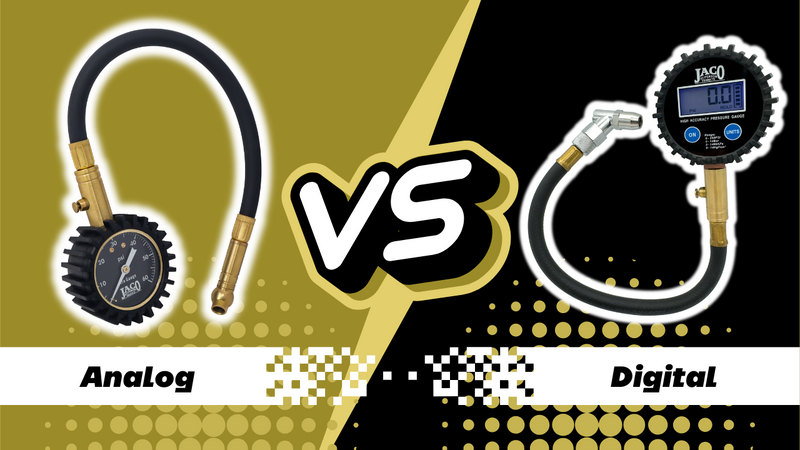
Credit: jacosuperiorproducts.com